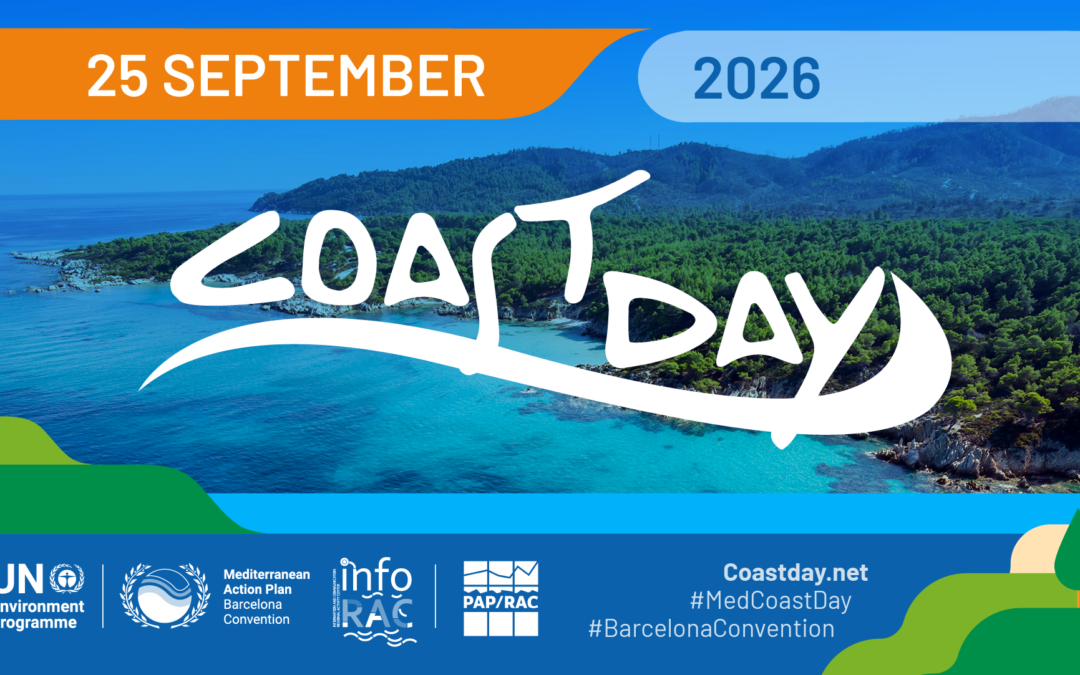
The new edition of Coast Day 2026, the annual Mediterranean Coast Day, took place last 25 September in Larnaca, Cyprus. This year’s event focused on Nature-based Solutions — solutions that harness nature to strengthen the resilience of coastal areas.
Every year, Mediterranean Coast Day brings together institutions, experts, communities and citizens to promote coastal protection and encourage concrete action to enhance coastal resilience. The event commemorates Slovenia’s ratification, in 2009, of the Protocol on Integrated Coastal Zone Management (ICZM), an agreement that brought together 21 Mediterranean countries to promote the sustainable development of coastal areas.
The UNEP/MAP event, implemented by PAP/RAC and co-organised with the Department of Environment of the Cypriot Ministry of Agriculture, Rural Development and Environment, within the framework of the DESIRMED project, aims to demonstrate how nature itself can represent a powerful ally in addressing the growing challenges affecting Mediterranean coastal areas.
The 2026 Theme
This year’s edition focused on Nature-based Solutions in a Mediterranean region increasingly exposed to the impacts of the climate crisis — from sea-level rise and coastal erosion to flooding, water scarcity and biodiversity loss.
Dunes, wetlands, Posidonia meadows and more natural approaches to shoreline management can provide important tools to address these challenges. Such solutions harness natural processes to absorb wave energy, retain sediments and regulate water flows, while also helping to protect ecosystems and biodiversity.
The theme is particularly relevant in a region characterised by densely urbanised coastlines, intense tourism pressure and growing vulnerability to extreme climate events.
Mediterranean Coast Day 2026 therefore promoted a change in approach to coastal management: moving from simply defending coastlines towards adaptive capacity, by integrating nature into planning and in the construction of more resilient coastal territories.
The Ambassador of the Mediterranean Coast
As in previous editions, PAP/RAC selected the Ambassador of the Mediterranean Coast, a title conferred on personalities from different fields, from the world of entertainment to institutional representation, from literature to navigation.
The recognition pays tribute to people who, through their work, experience and commitment, contribute to raising awareness among the people of the Mediterranean and beyond about the importance of understanding, protecting and respecting the coasts and their precious environment.
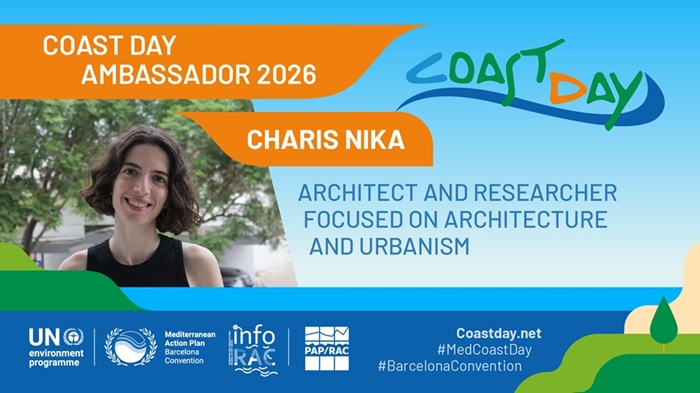
For the 2026 edition, the title was awarded to Charis Nika, Architect and Researcher focused on architecture and urbanism.
INFO/RAC participates in the celebrations, to pay homage to the ambassador with a video developed to promote the protection of the coast in Mediterranean.
A Giant Interactive Map
Among the initiatives of the Festival, a Giant DesirMED Interactive Map was set up in Piazza Europa in Larnaca. Produced by Giant Interactive Maps, the map, measuring 17 metres by 9.5 metres — covering an area of 161.5 square metres — allowed visitors to walk “across” the Mediterranean, from the Atlantic coast of Portugal to the shores of Cyprus.
At every point on the map, visitors were able to discover a Nature-based Solution, an ecosystem or a species, jointly developed by the eight DesirMED regions and the Cypriot partners hosting the event — CMMI (Cyprus Marine and Maritime Institute), Cyprus Energy Agency and IUCN Centre for Mediterranean Cooperation — and assessed against the IUCN Global Standard for Nature-based Solutions.
The event also featured the first edition of the DesirMED Adaptation Festival, with talks, interactive activities, exhibitions, games and music dedicated to climate adaptation in the Mediterranean. A photography exhibition also showcased individual and collective efforts across the region to create landscapes that were more resilient to the impacts of climate change.
Mediterranean Coast Day 2026 therefore aims to promote a shift in the way coastal areas are managed: moving from simply defending coastlines towards building adaptive capacity, by integrating nature into planning and creating more resilient coastal territories.