
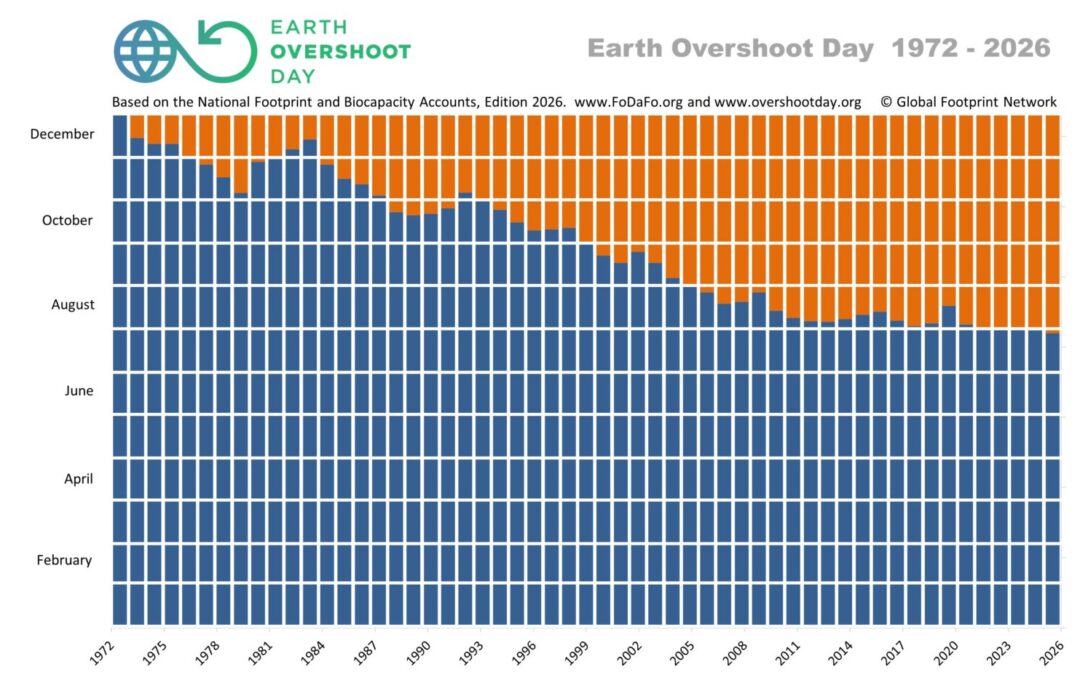
Today marks Earth Overshoot Day, the date when humanity’s demand on nature exceeds the Earth’s ecosystems’ ability to regenerate the resources used within the year. According to the Global Footprint Network, humanity is currently using natural resources at a rate 73% higher than the capacity of ecosystems to regenerate them, meaning that we are living as if we had 1.73 Earths available to sustain our needs. This represents the highest level of ecological overshoot ever recorded.
Several factors contribute to ecological overshoot: cars, power plants and industrial facilities emit more CO₂ than the biosphere can absorb.
More freshwater is being consumed than is naturally replenished; more trees are being cut down than can regrow; and more fish are being caught than fish stocks are able to reproduce. This excessive use depletes natural capital and threatens long-term economic security worldwide.
According to the special report “Prepared for the Predictable? Overshoot and the Failure of Countries to Ready Themselves“, produced by the Global Footprint Network and Greenings for Earth Overshoot Day, despite this situation, almost no national government considers resource security a central element of its economic planning.
Through this analysis, the Global Footprint Network and Greenings identified which countries recognize ecological overshoot as an economic threat and the extent to which their policies are actually prepared to address it. According to the study, most countries consider sustainability a marginal issue: no country fully connects economic planning with the physical limits of natural resources.
In particular:
- None of the national strategies analyzed meaningfully address the risks arising from ecological overshoot.
- China’s current Five-Year Plan received the highest score.
- Argentina’s national strategy documents ranked lowest among those reviewed.
- The European Union received a lower score than might be expected given its sustainability reporting commitments, highlighting a gap between publicly stated commitments and actual economic planning.
According to David Lin, one of the lead authors of the study and Chief Scientist at the Global Footprint Network: “Overshoot is not a distant environmental concern. It is already producing economic impacts. Countries that plan for a resource-constrained future will be the ones best positioned to withstand it. Right now, almost none are.”
The authors of the report suggest that every country should establish a task force or parliamentary commission to map resource dependencies, assess financial exposure, and identify strategies to strengthen resilience before the next resource shock occurs.