The Mediterranean, one of the world’s leading tourist destinations with nearly 400 million visitors each year, is increasingly exposed to the impacts of the climate crisis.
To address these challenges and promote adaptation strategies, Plan Bleu has published two new documents within the framework of the ADAPT-Pelagos project, implemented with the support of the Prince Albert II of Monaco Foundation and the French Agency for Ecological Transition (ADEME).
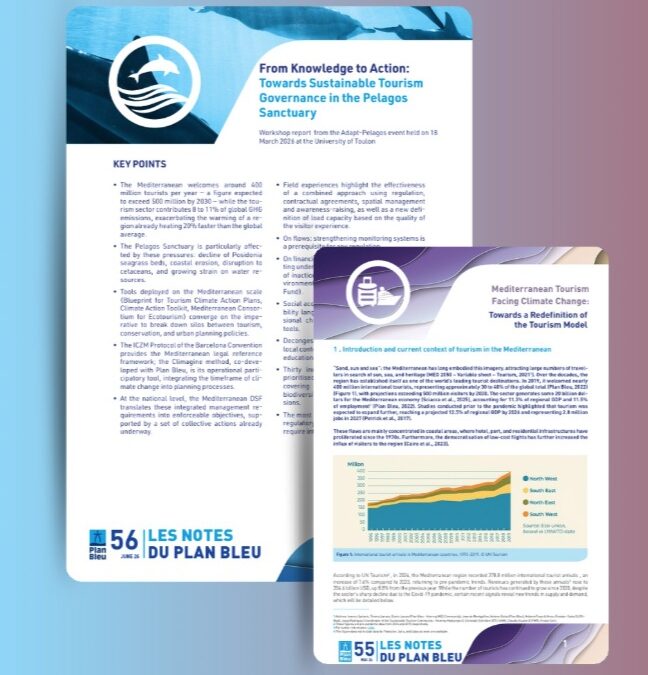
The first study, From Knowledge to Action: Towards Sustainable Tourism Governance in the Pelagos Sanctuary, developed by the University of Toulon following work carried out in March 2026, proposes an integrated approach to coastal tourism management.
The report highlights the need to move beyond sectoral approaches in order to build a shared and measurable transboundary governance framework within the Pelagos Sanctuary.
At the core of the document is the definition of 30 indicators related to climate, biodiversity, circular economy, and governance. Among the priorities are indicators based on already available data, such as monitoring the number of days subject to water-use restrictions, while also highlighting the complexity of indicators requiring harmonisation across different countries.
The report also emphasises the need for an integrated governance framework combining regulation, digital tools for managing and redistributing tourist flows, and Nature-based Solutions (NbS). Among the recommendations is also the legal recognition of ecological damage and the involvement of different generations of residents to ensure social acceptance of the measures adopted.
The second publication, Mediterranean Tourism Facing Climate Change: Towards a Redefinition of the Tourism Model, analyses the relationship between the tourism sector in the Mediterranean in light of the climate crisis.
The document underlines how tourism represents a dual reality: a victim of environmental impacts and at the same time a significant contributor to emissions.
The study outlines three possible scenarios up to 2050: from Business as Usual to a profound spatio-temporal transformation and proposes concrete levers such as the development of eco-mobility, improved energy efficiency inspired by traditional Mediterranean architecture, and the use of Nature-based Solutions.
The priorities emerging from stakeholder discussions further highlight the need to assign an economic value to environmental damage, strengthen education and awareness among younger generations through innovative tools, and foster greater collaboration between nature conservation actors, the tourism sector, and urban planning.
The initiative represents another step towards building more sustainable and resilient tourism models in a strategic area such as the Pelagos Sanctuary, one of the Mediterranean’s main marine ecosystems dedicated to the protection of marine mammals.
Learn more