
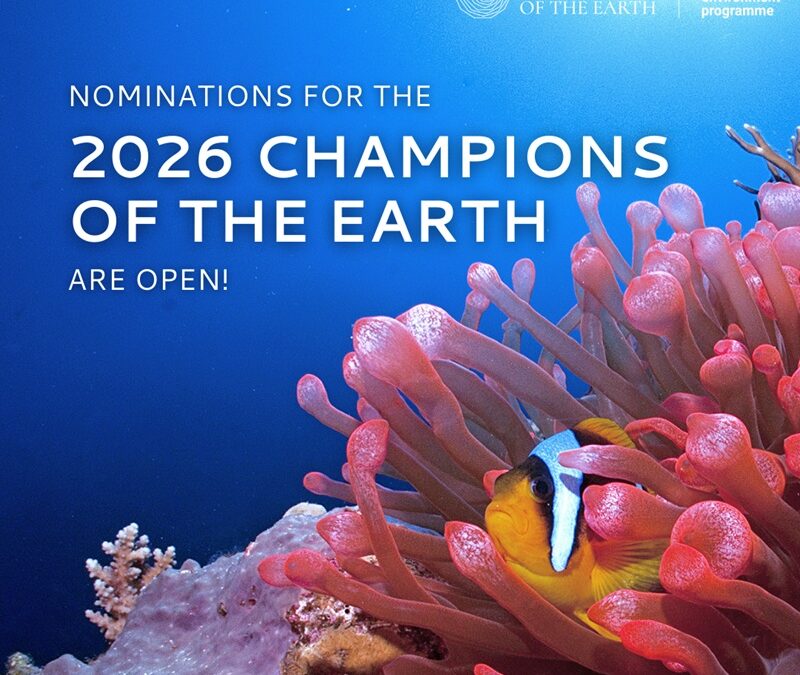
Applications are now open for the world’s highest environmental honour: the United Nations Environment Programme (UNEP) has launched the Champions of the Earth 2026 award. This year, the prize focuses on leaders at the forefront of ocean protection, an ecosystem essential to life on Earth and increasingly under pressure.
Established in 2005, Champions of the Earth recognizes individuals and organizations that promote solutions to the world’s most pressing environmental challenges. These are the people who, in practice, transform economies, drive political progress, promote environmental justice, and safeguard natural resources for future generations. Since its inception, the award has recognized 127 laureates.
This edition focuses on those who, through their work, are committed to protecting and restoring ocean health. Covering more than 70% of the planet, oceans are crucial to climate stability, biodiversity, food security, and sustainable economic development.
Unfortunately, only 15% of coastlines remain ecologically intact. Pollution, habitat loss, sediment runoff, and untreated wastewater are degrading marine ecosystems, causing biodiversity loss and threatening communities that depend on the sea.
The Champions of the Earth 2026 awards will honour leaders whose work provides solutions to restore marine and coastal ecosystems, reduce climate risks, and create sustainable livelihoods.
The key focus areas of this year’s award are pollution prevention, ecosystem protection and restoration, sustainable blue economies, and science, data, and cooperation.
Applications, open until 15 April, are available to individuals, organizations, and government entities under the categories of Policy Leadership, Inspiration and Action, Entrepreneurial Vision, and Science and Innovation. Winners will be announced at the end of 2026.
UNEP is the leading global voice on the environment. It provides leadership and encourages partnership in caring for the environment by inspiring, informing and enabling nations and peoples to improve their quality of life without compromising that of future generations.