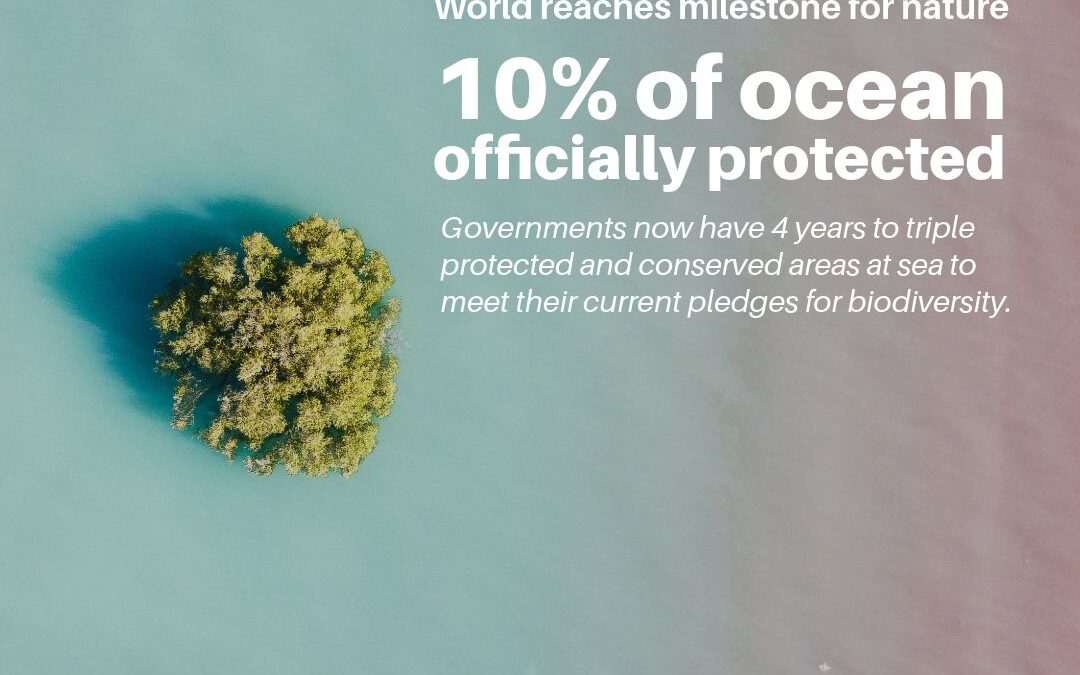
A very important milestone has been reached for the entire international community: 10.01% of the ocean is now officially designated as protected or conserved areas. The result is the outcome of efforts at the national level to designate vast ocean areas, but it is also a reminder of the need to triple protected and conserved areas at sea by 2030. By that date, an area approximately the size of the Indian Ocean will need to be designated if international ambitions for ocean protection are to be achieved.
A historic achievement, therefore, but much still needs to be done to achieve the goal of conserving 30% of the Earth’s land and seas by 2030.
According to data from the Protected Planet Report 2024, produced by UNEP-WCMC and IUCN, in 2024 8.6% of ocean and coastal areas were already included in documented protected areas. Over the past two years, about 5 million square kilometres of ocean have been added, an area larger than the European Union.
“We all depend on the ocean for our survival; over half of the world’s oxygen is produced by life in the ocean. The great strides at the national level over the past two years to protect more than 10 per cent of the marine realm is therefore a moment for celebration. But reaching this milestone is a reminder of how much work there is still to do. The coverage of protected and conserved areas at sea still needs to triple by 2030 and it is critical that both new and existing areas are managed effectively todeliver positive outcomes for people and nature” said Neville Ash, Director of UNEP-WCMC.
Increasing the coverage of these areas is essential, but not sufficient. This figure falls within the Kunming-Montreal Global Biodiversity Framework (KMGBF), which highlights that protected and conserved areas must be effectively conserved and managed, and equitably governed. The Protected Planet Report 2024, the official progress report from the UN Environment Programme World Conservation Monitoring Centre (UNEP-WCMC) and the International Union for Conservation of Nature (IUCN), shows that available data are insufficient to fully measure and understand the effectiveness of protected and conserved area systems: only 1.3% of the ocean is covered by protected areas whose management effectiveness has been assessed and reported.
The milestone is based on the latest update of the World Database on Protected and Conserved Areas (WDPCA), which brings together national data along with areas beyond national jurisdictions. This database is jointly managed by UNEP and IUCN.
In previous biodiversity commitments, the Aichi Biodiversity Targets set a goal of protecting 10% of the ocean by 2020: six years after the deadline, this objective has finally been achieved.
Despite progress, challenges remain in international waters: about 95% of habitats by volume are found in the open ocean, but only 1.66% is protected. The UN High Seas Treaty, which entered into force in January 2026, aims to establish protected areas in these zones as well.
Recent analyses using the MPA Guide show that many marine protected areas are not actively managed and that some are subject to destructive activities. Governments and stakeholders are encouraged to monitor management effectiveness to ensure concrete outcomes for people and nature.
The next Protected Planet Report 2027 will provide a new official assessment of global progress towards the goal of protecting 30% of terrestrial and marine ecosystems by 2030.