
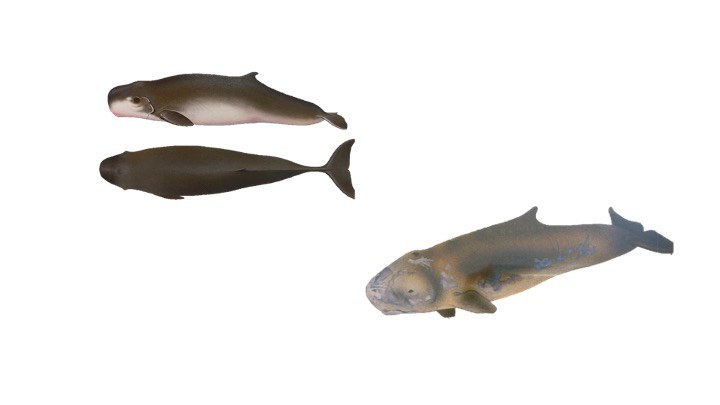
The discovery comes thanks to the European project LIFE-CONCEPTU MARIS, led by ISPRA: the “pygmy sperm whale” (Kogia breviceps), previously thought to be absent from the Mediterranean, has been identified through environmental DNA (eDNA) analysis—the collection of all genetic traces an organism leaves in its environment.
This was not a direct sighting or captured in underwater footage; the whale’s presence was revealed through genetic traces released into the marine environment and collected from simple water samples.
This innovative technique opens new possibilities for studying and monitoring hard-to-observe species and highlights the potential of “molecular investigation” as a key tool for exploring largely unknown ecosystems.
The discovery was made by researchers from the University of Milan-Bicocca, in collaboration with ISPRA, the Stazione Zoologica in Naples, and the University of Valencia, all part of the LIFE-CONCEPTU MARIS project, which monitors cetaceans and sea turtles in the Mediterranean using regular ferry routes as platforms for collecting data and samples.
The pygmy sperm whale, extremely elusive in open waters, reaches about 3–3.5 meters in length, inhabits tropical and warm temperate seas, and primarily feeds on squid, which it detects using its sophisticated biosonar. To detect it, researchers collected seawater samples from commercial ferries in transit.
In total, 12 liters of water were collected at each of the 393 sampling points across the central-western Mediterranean. The water was immediately filtered onboard the ships, capturing all suspended biological material containing DNA fragments.
In the lab, using advanced sequencing techniques, researchers traced the DNA of Blainville’s beaked whale in 10 different samples, corresponding to at least five independent presence events. The traces were spread across a wide area, from the Tyrrhenian Sea to the Strait of Gibraltar.
The DNA was detectable thanks to the whale’s defense strategy: when threatened, Kogia species expel a reddish-brown fluid from an internal “ink sac,” similar to squid. This creates a large cloud, and when expelled in large quantities (up to 11 liters at a time), it is extremely rich in DNA.
Researchers believe that a stable, established population of Blainville’s beaked whales exists in the Mediterranean.
An even more intriguing possibility is that this population represents a subpopulation isolated for a long period. This is suggested by the discovery of a unique genetic profile, different from Atlantic specimens near Gibraltar, indicating a potentially long evolutionary history within the Mediterranean basin.
The discovery has important practical implications: it supports calls to officially include Blainville’s beaked whale in international protection lists for the Mediterranean, such as the ACCOBAMS agreement (Agreement on the Conservation of Cetaceans in the Black Sea, Mediterranean Sea, and Contiguous Atlantic Area), ensuring its conservation.