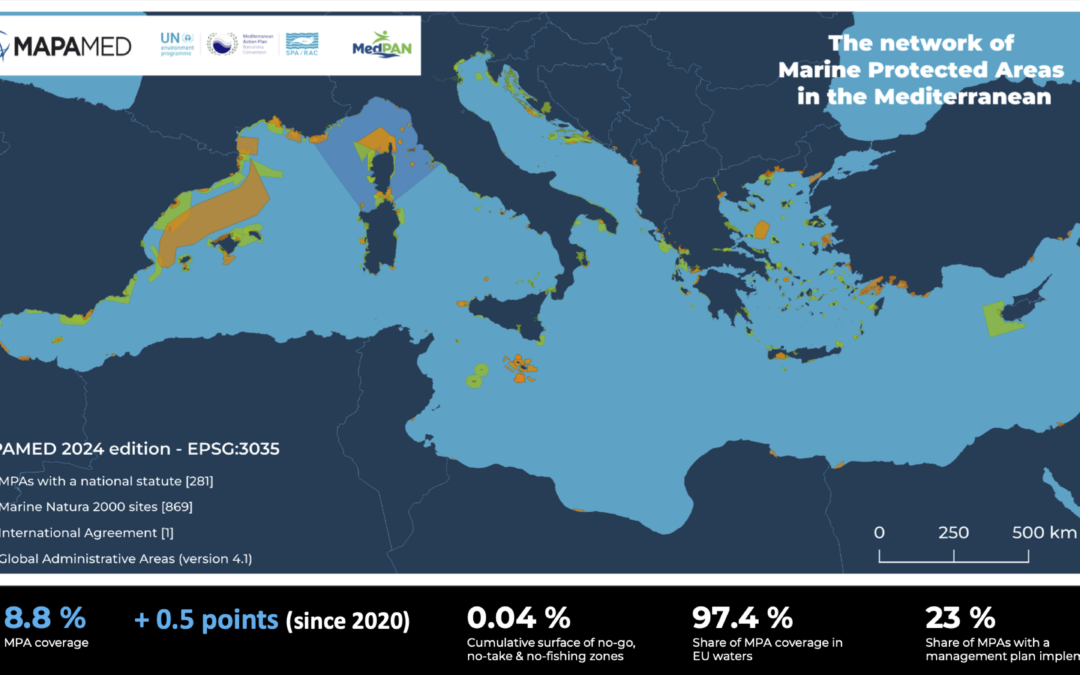
The Mediterranean Sea is still far from reaching the ambitious targets for the protection of its waters. According to a preview of the upcoming report “Status of MPAs in the Mediterranean Sea 2025”, prepared by MedPAN, the network of Marine Protected Area (MPA) managers in the Mediterranean, currently only 8.8% of the basin is designated as an MPA, with a minimal increase of 0.5 percentage points compared to 2020. Areas under strict protection account for just 0.04%.
Since 2010, MedPAN, in collaboration with the Regional Activity Centre for Specially Protected Areas (SPA/RAC) of UNEP/MAP, has been monitoring MPAs across the Mediterranean. The results reveal a strong imbalance: over 97% of MPAs are located in EU waters, while countries in the southern and eastern Mediterranean remain heavily underrepresented.
“Regional cooperation is essential, and initiatives such as the EU Mediterranean Pact can help close this gap,” says Carole Martinez, Senior Policy Manager at MedPAN.
Management is also a major challenge: only 23% of the MPAs studied have a management plan that is actually implemented. Although awareness of major pressures is high, and 42% of MPAs report taking measures to mitigate them, other critical issues receive less attention. For example, only 10% assess tourist carrying capacity, despite high seasonal pressure on many Mediterranean coastal areas.
The Mediterranean is warming three times faster than the global ocean, making it one of the hotspots of climate change. Yet only 32% of MPA managers consider climate change a priority, and only 30% take concrete actions to address its impacts. To respond to this emergency, MedPAN, together with CSIC, WWF Mediterranean, IUCN Mediterranean, the Union for the Mediterranean, and SPA/RAC, launched the 100MPA MedAlliance initiative, aimed at strengthening the climate resilience of 100 MPAs by 2030. The initiative will provide, among other things, tools, technical advice, and policy support to increase the capacity of MPAs to tackle the climate crisis.