Within the context of the Mediterranean policies of the Barcelona Convention and the international frameworks of the United Nations Decade of Ocean Science, Gaia First and the Regional Activity Centre for Specially Protected Areas (SPA/RAC) have announced a strategic collaboration aimed at strengthening marine and coastal conservation in the Mediterranean.
The agreement represents a significant step towards achieving Good Environmental Status of marine ecosystems, in line with the Integrated Monitoring and Assessment Programme (IMAP) of the Barcelona Convention. The goal is to improve knowledge, protection, and sustainable management of marine resources through an integrated and multidisciplinary approach.
The partnership will focus on several key areas, including the collection and analysis of scientific data such as environmental DNA, underwater noise monitoring, and plastic pollution, as well as the study of anthropogenic pressures affecting ecosystems. Particular attention will also be given to the integration of traditional ecological knowledge, the promotion of citizen science, and the strengthening of environmental education.
A central element of the initiative is the international programme Guardians of Gaia, supported by UNESCO, which aims to create a network of local and regional hubs capable of connecting scientific knowledge, traditions, and communities.
Its maritime component, Mare Nostrum, foresees both the creation of coastal hubs along the Mediterranean and an expedition aboard a large sailing vessel, which will involve young explorers in an experience of research, training, and environmental diplomacy. The Mediterranean will serve as a pilot model for the progressive establishment of 150 hubs in 60 countries by 2030.
The hubs will not be simple research centers, but living spaces, meeting places for institutions, citizens, fishermen, schools, and researchers, where scientific knowledge intertwines with traditional practices, giving rise to innovative models of participatory conservation.
Aboard the sailing vessel, a first scientific, educational, and cultural expedition will also set sail, connecting Tangier to Monaco, with stops in Cartagena, Tunis, Palermo, and Nice. The initiative will offer forty young international explorers a multi-week immersion, combining scientific data collection, environmental diplomacy, intercultural learning, and the transmission of traditional knowledge.
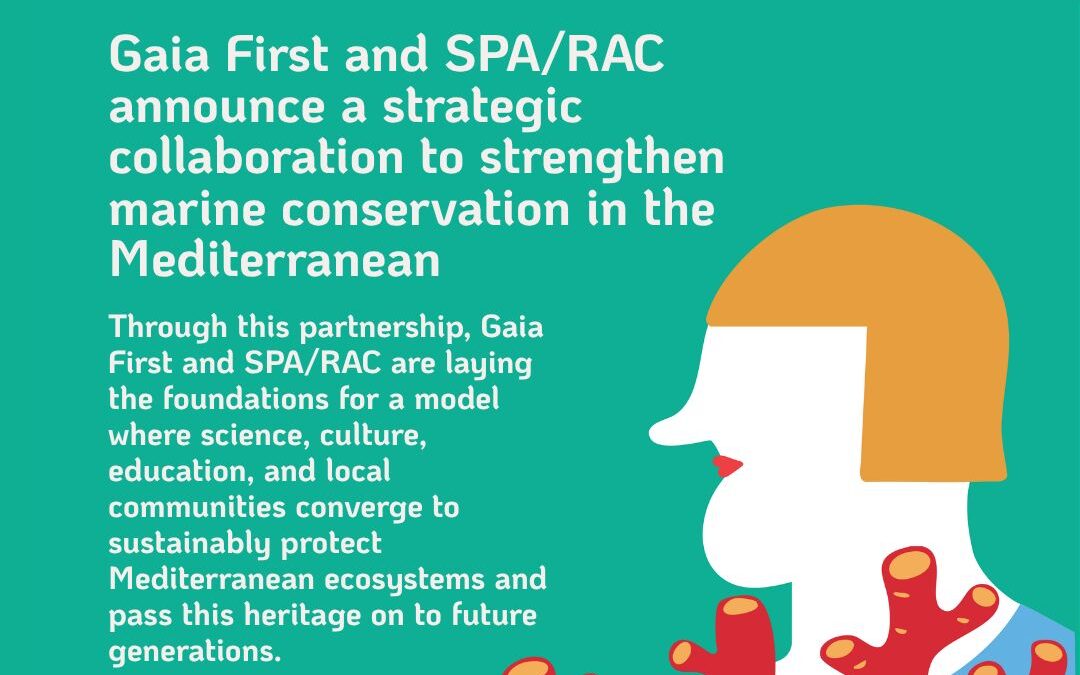
The collaboration between Gaia First and SPA/RAC thus aims to build a bridge between regional policies and global initiatives, contributing to the achievement of the Sustainable Development Goals of the 2030 Agenda. A model that unites science, culture, and education, with the ambition of protecting the natural heritage of the Mediterranean and passing it on to future generations.
Based in Tunis since 1985, the Regional Activity Centre for Specially Protected Areas (SPA/RAC) supports the Contracting Parties of the Barcelona Convention in their efforts for the protection and sustainable management of marine and coastal biodiversity in the Mediterranean. It contributes in particular to the conservation of species and habitats, as well as to the development and effective management of marine and coastal protected areas.
The Integrated Monitoring and Assessment Programme (IMAP), adopted within the framework of UNEP/MAP, provides a common framework to monitor the state of the marine and coastal environment and to guide actions towards the achievement of Good Environmental Status.
Gaia First is an international organization committed to the protection of biodiversity through a systemic approach that unites science, education, and environmental, scientific, and cultural diplomacy.
Guardians of Gaia is an official Action of the United Nations Decade of Ocean Science.