The European Commission defines for the first time a coordinated approach for both types of territory.
The European Commission has adopted for the first time two specific strategies, one for EU islands and one for coastal communities. It is a new European approach to support both types of territories and therefore unlock their potential also in the long term.
The initiatives concern 17 million people living in over 4,000 islands spread across 16 Member States, including the three island nations of Cyprus, Ireland and Malta, and 95 million citizens — equal to 21% of the EU population — living along the 70,000 kilometres of European coasts or in the coastal areas of 22 countries.
The objective of the Commission is to adopt an integrated approach that takes into account the specificities of these territories in the different strategic fields — from the economy to connectivity, from energy to the environment, up to demography and security — transforming structural weaknesses into opportunities for growth and resilience.
For Raffaele Fitto, Executive Vice-President for Cohesion and Reforms: “For the first time, the European Union has dedicated strategies for its islands and coastal communities recognising their unique challenges and high potential. By improving transport, boosting green energy, strengthening local economies, and addressing demographic challenges, we’ll turn obstacles into opportunities, making these territories key to a sustainable, competitive Europe.”
Most EU islands share common challenges that affect the economic sustainability and quality of life of their inhabitants, including geographical isolation, high transport costs, excessive dependence on tourism, vulnerability to climate change and scarcity of water resources.
Coastal communities represent a strategic resource for the Union. These territories combine a significant environmental, cultural and maritime heritage with strong potential linked to the sustainable blue economy. However, they are also among the most exposed to the effects of climate change, marine biodiversity loss and pollution, as well as economic and social pressures such as unbalanced tourism, lack of affordable housing, seasonality and limited employment opportunities, which fuel youth emigration.
In the face of these challenges, the European Union is focusing on a tailored approach. The two strategies are designed to work in a complementary way, strengthening each other and taking into account the specificities of the different territories. The idea is to build a coherent action framework, integrated into European policies and funding, capable of increasing economic opportunities, improving quality of life and strengthening resilience.
A strategy for European islands
The strategy for islands develops along four main directions. The first concerns economic development, competitiveness and innovation, through support for entrepreneurship, diversification of local economies, promotion of more sustainable tourism and acceleration of digital transformation, together with reducing connectivity gaps that still penalise many island territories.
A second area of intervention is dedicated to energy security and environmental protection, with measures aimed at accelerating decarbonisation, promoting the spread of renewable energy, improving adaptation to climate change and protecting biodiversity. Great attention is also given to local communities, through strengthening public services, healthcare, housing supply and education, with the aim of countering depopulation and creating conditions that allow young people to build their future in their territories of origin.
Finally, the aim is to strengthen crisis preparedness and emergency response capacity, from natural disasters worsened by the climate crisis to maritime risks and other emerging threats.
The strategy for coastal communities
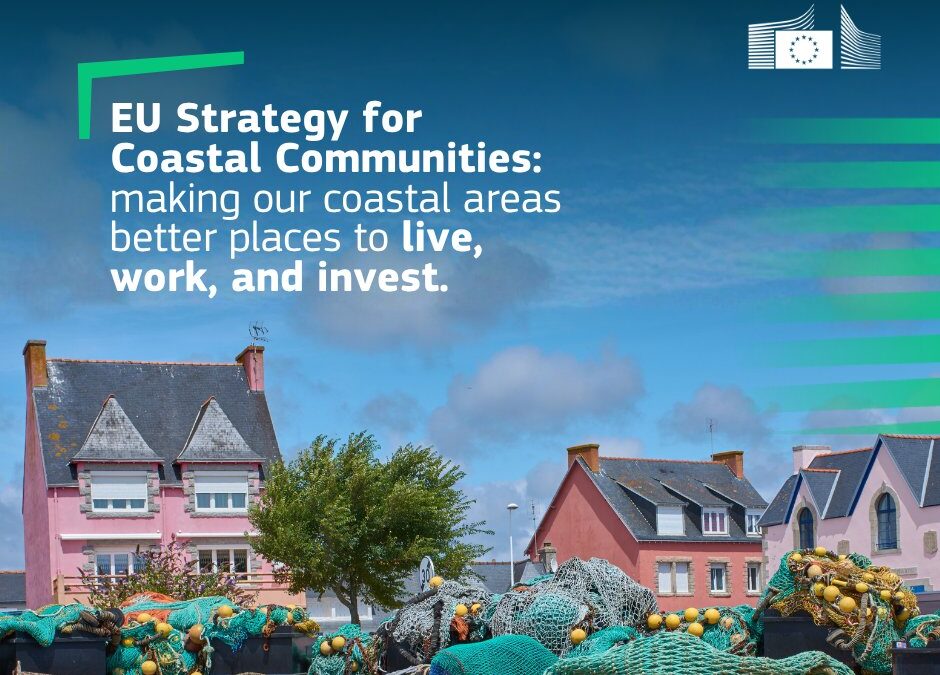
Alongside that for islands, the Commission has also presented a strategy for coastal communities, structured around three priorities: prosperity, resilience and liveability.
On the economic level, the objective is to strengthen a more dynamic and diversified blue economy, supporting innovation and new business models linked to the sea, from fishing tourism to bioeconomy up to offshore renewable energies, with the creation of quality employment.
A second line of intervention concerns strengthening the resilience of coastal communities in the face of climate change and other environmental, economic and social pressures. In this context, a central role will be played by the OceanEye initiative, recently announced by the Commission.
The strategy also aims to make coastal areas more attractive and inclusive places, where people of all ages can live and work benefiting from adequate services and a quality environment, without renouncing the protection of maritime cultural heritage and local identities.
The proposed approach focuses on solutions built starting from the needs of the territories, recognising the deep differences that exist between the different European coastal realities. Among the measures envisaged are greater participation of communities in maritime spatial planning through the future Ocean Act, support for blue bioeconomy clusters and local supply chains, the creation of a certification system for blue carbon credits, and mapping of investments and support for capacity development for coastal adaptation, with the participation of the European Investment Bank and the EU missions for climate change adaptation and for restoring our oceans and waters.
Both strategies are part of the European Ocean Pact, launched in 2025, and are linked to broader EU policies on climate, cohesion and sustainable development. The outermost regions are not included in these measures: a separate strategy is foreseen for them, which will be presented by the end of the year.