
The results of the European State of the Climate (ESOTC) 2025 report have been published by the European Centre for Medium-Range Weather Forecasts (ECMWF), which implements the Copernicus Climate Change Service, and by the World Meteorological Organization (WMO).
The report brings together the work of around 100 scientific contributors and provides a comprehensive overview of key changes in climate indicators across the world’s fastest-warming continent, including cold environments, marine ecosystems, rivers and lakes, and wildfire risk.
According to the report, rapid warming in Europe is reducing snow and ice cover, while dangerously high air temperatures, drought, heatwaves, and record ocean temperatures are affecting regions from the Arctic to the Mediterranean. Europe, along with many other regions worldwide, is exposed to record heatwaves on land and at sea, devastating wildfires, and ongoing biodiversity loss, with consequences for societies and ecosystems across the continent.
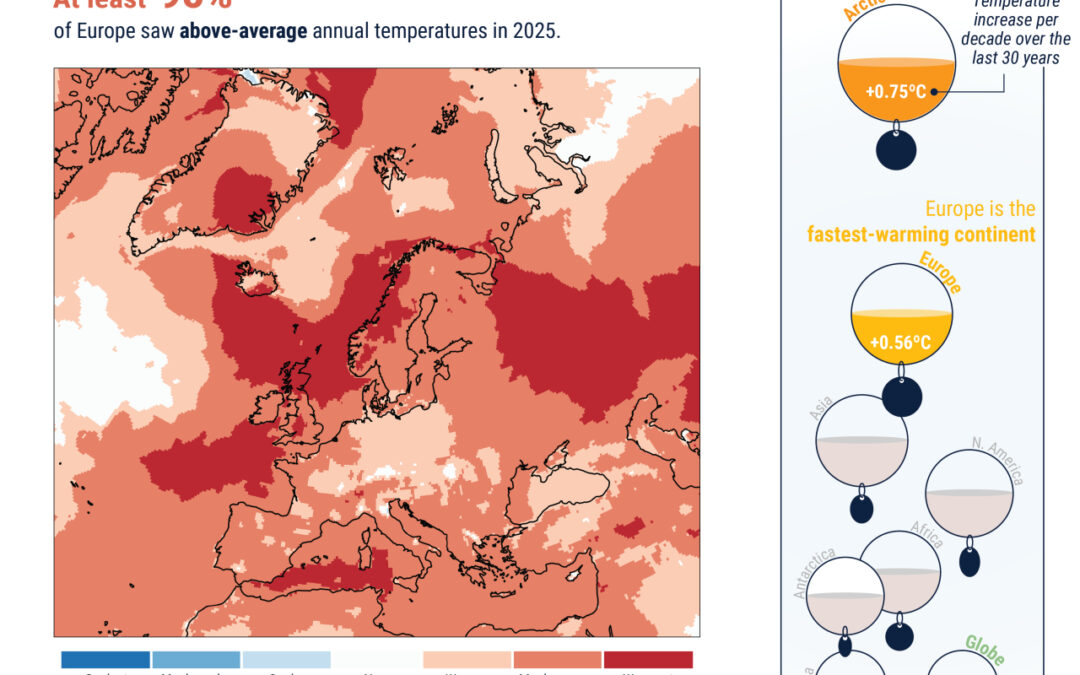
Among the main findings, at least 95% of Europe experienced above-average annual temperatures in 2025. The average annual sea surface temperature in the European region was the highest ever recorded, and 86% of the region experienced at least “strong” marine heatwaves. In addition, climate change is one of the main drivers of biodiversity loss.
For Celeste Saulo, Secretary-General of the World Meteorological Organization:
“Our joint effort to produce the ESOTC reflects how climate change is impacting biodiversity and the bold initiatives taken by European policy makers to protect and restore it.”
Record marine heat and ocean warming
The global ocean has absorbed about 90% of the excess heat caused by human-induced greenhouse gas emissions. In 2025, the European ocean region experienced its highest-ever recorded annual sea surface temperature, marking the fourth consecutive year of record heat. This long-term trend has a negative impact on biodiversity, species, and habitats.
The entire Mediterranean Sea experienced at least one day of “strong” marine heatwave conditions in each of the past three years. In 2025, the average annual sea surface temperature was the second highest ever observed.
Rising temperatures and more intense wildfires
Across Europe, 2025 saw widespread warm conditions, with above-average temperatures recorded across at least 95% of the continent. Heatwaves affected large areas, from the Mediterranean to the Arctic.
Many regions experienced more days than usual with at least “strong” heat stress, with southern and eastern Spain seeing up to 50 more days than average with “feels-like” temperatures above 32°C.
Numerous extreme events in 2025 – including droughts, wildfires, and land and marine heatwaves – affected biodiversity in terrestrial and marine ecosystems. In addition, nature is under increasing stress due to habitat loss and shifting ranges, changes in seasonal cycles driven by higher temperatures, and changes in precipitation patterns.
The report highlights concrete examples, such as the effects of marine heatwaves on seagrass meadows in the Mediterranean Sea and peatland wildfires.
For Samantha Burgess, Strategic Lead for Climate at ECMWF:
“The ESOTC 2025 paints a stark picture: the pace of climate change demands more urgent action. With rising temperatures, and widespread wildfires and drought, the evidence is unequivocal; climate change is not a future threat, it is our present reality. In confronting the impact on biodiversity loss, we need to match the speed of adaptation happening in the clean energy transition and at the same time, ensure robust science continues to underpin our policies and decisions.”
The European Union has committed to legally binding targets to restore ecosystems at scale, including the protection of at least 20% of land and sea areas by 2030 and all degraded ecosystems by 2050.
About Copernicus and ECMWF
Copernicus is the Earth observation component of the European Union’s Space programme, looking at our planet and its environment to benefit all European citizens. The programme is coordinated and managed by the European Commission and implemented in partnership with the Member States and European organisations.
The European Centre for Medium-Range Weather Forecasts (ECMWF) is both a research institute and a 24/7 operational service, producing global numerical weather predictions and other data for our Member and Co-operating States and the broader community. It operates a world-class supercomputer facility for weather forecasting and holds one of the largest meteorological data archives.