
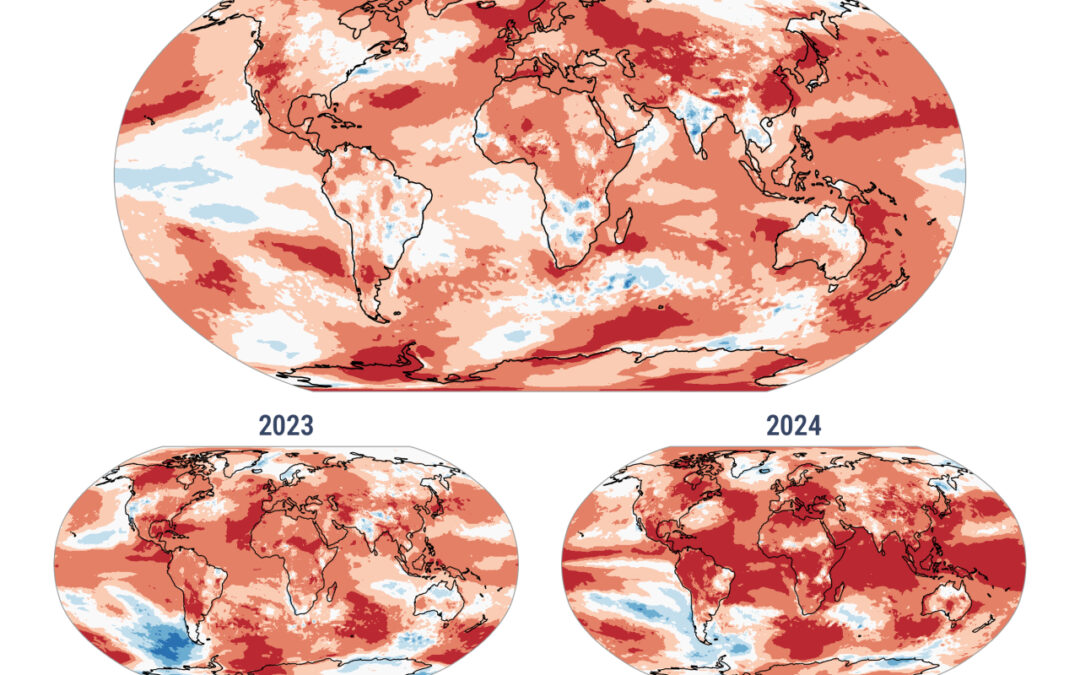
This was announced by the data published in the Global Climate Highlights report released by Copernicus.
According to the report, global surface air temperature was 1.47 °C above the pre-industrial level, following the 1.60 °C recorded in 2024, the warmest year ever observed. The current level of long-term global warming is estimated at around 1.4 °C above the pre-industrial level.
Based on current trends, the goal of the Paris Agreement—namely limiting the increase in global temperatures to 1.5 °C—could be reached by the end of this decade, more than ten years earlier than expected at the time the agreement was signed.
From 2023 to 2025, temperatures were higher due both to the accumulation of greenhouse gases in the atmosphere and to elevated sea surface temperatures across all oceans, associated with the El Niño phenomenon and other factors of ocean variability, amplified by climate change.
As in 2023 and 2024, a significant part of the globe was much warmer than average in 2025. Surface air and sea temperatures in the tropics were lower than in 2023 and 2024, but still well above average in many areas outside the tropics.
Antarctica recorded its highest average annual temperature ever, while the Arctic experienced its second highest.
According to Florian Pappenberger, Director-General of ECMWF, the report “confirms that Europe and the world are experiencing the warmest decade ever recorded and that the European Commission’s investment in Copernicus continues to be essential. As an international organization serving 35 nations, ECMWF provides the world’s most advanced science to enable informed decisions and, ultimately, to take action to adapt to climate change, because every year and every degree matter. Preparedness and prevention remain possible, but only when action is guided by solid scientific evidence.”
In Europe, 2025 was the third warmest year ever recorded, with an average temperature of 10.41 °C, 1.17 °C above the 1991–2020 reference period average and 0.30 °C below the warmest year, 2024.
Copernicus is the Earth observation component of the European Union’s space programme, which studies our planet and its environment for the benefit of all European citizens. The programme is coordinated and managed by the European Commission and implemented in collaboration with the Member States and several European organizations.